The internet is not running out of content. It is running out of proof that real people care. That is the tension behind AI vs user-generated content. Most brands are treating it like a production question. Can AI make more posts? Can it generate better scripts? Can it lower creative costs? The answer is yes, in many cases. But that is not the question that matters.
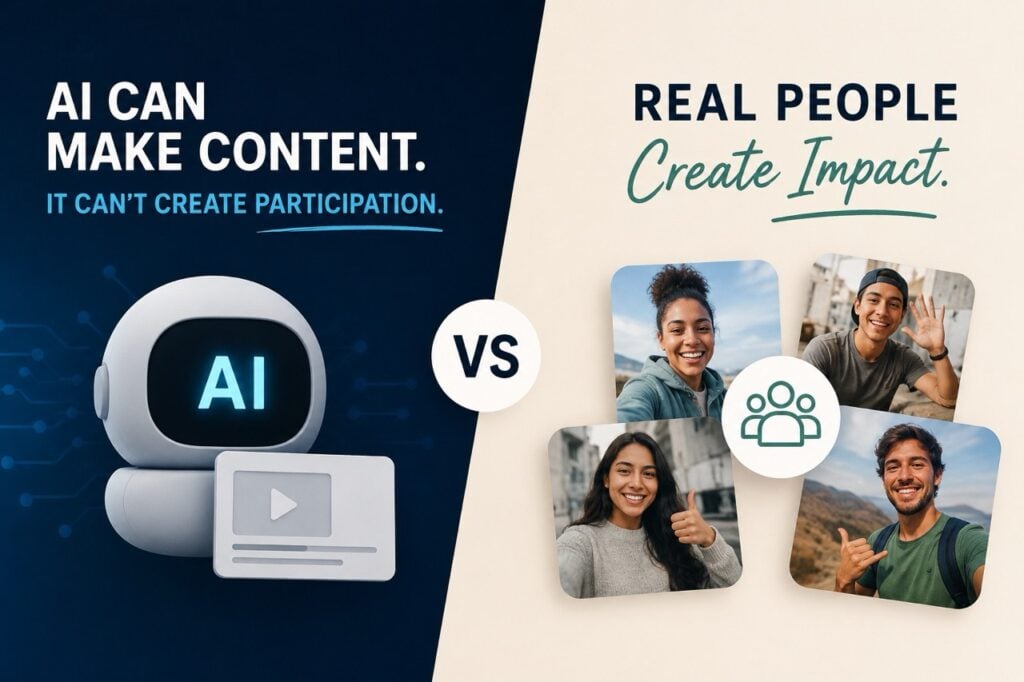
AI can produce content. It cannot create participation. And participation is where the real value of UGC lives.
HubSpot’s 2026 State of Marketing report says 80% of marketers use AI for content creation, while 75% use it for media production. The same report argues that AI is now baseline, not the differentiator, because the real gap is how brands use it without losing humanity.
That should change how brands think about UGC.
AI vs User-Generated Content Is Not a Format Debate
A brand can use AI to write a testimonial-style caption. It can generate a synthetic product image. It can create a video script that sounds like a customer story. Some of that output may be useful inside a marketing workflow.
But UGC is not just a format. It is evidence.
A customer recording a review, a fan submitting a reaction, or a community member sharing a story carries meaning because someone chose to participate. There is friction in that choice. There is identity in it. There is a public signal that the relationship between brand and audience is not entirely manufactured.
That is what AI cannot replicate honestly.
The strongest user-generated content does not say, “Here is another asset.” It says, “Someone showed up.”
Authentic UGC Matters More When Synthetic Content Gets Better
Synthetic content is becoming harder to detect. The Verge reported in June 2026 that AI “content creators” are increasingly blending into social feeds, helped by mainstream tools that make synthetic personas easier and cheaper to create. The same report notes that platform rules often focus on labeling individual AI-generated posts, not clarifying whether an account represents a real person.
That distinction matters for brands.
If audiences are unsure whether a creator is real, whether a recommendation is synthetic, or whether a story has been generated, then authentic UGC becomes a stronger trust signal. It shows that a real person had enough motivation to take part.
This does not mean brands should rely on random social scraping or hope customers will organically post the perfect clip. That model is too inconsistent. It creates quality issues, rights issues, and workflow chaos.
The better model is structured participation systems: clear prompts, guided capture, consent built into the flow, and an organized content library after submission.
Structure does not weaken authenticity. It makes authenticity usable.
AI Content Marketing Still Needs Human Signals
AI content marketing will keep growing because it solves real workflow problems. It helps teams draft faster, repurpose more efficiently, localize campaigns, and test creative variations. Used well, it can reduce the blank-page problem and speed up execution.
The mistake is treating AI output as a replacement for customer-generated content.
Emplifi’s 2026 Digital Authenticity in the Age of AI research found that 93% of consumers say authentic engagement builds trust, and 63% cite user-generated content as a top source of authenticity when evaluating brands. The report also found that more than 90% of consumers expect brands to disclose AI usage in marketing.
That is the line brands need to respect. Consumers are not rejecting technology. They are rejecting uncertainty.
They want to know what came from the brand, what came from automation, and what came from people with lived experience. A brand that blurs those lines may win a short-term efficiency gain and lose long-term credibility.
That trade is not worth it.
The Future of Customer-Generated Content Is Guided Participation
For years, many brands treated UGC as something they discovered after it happened. Someone posted a great video. A team found it. Someone asked for rights. Someone downloaded it, renamed it, moved it into a folder, and hoped the permission trail was clear later.
That process does not scale.
The next phase of customer-generated content will be more intentional. Brands will create specific prompts for customers, fans, employees, students, donors, or community members. Participants will know what kind of story to share. Marketing teams will receive content with context and consent attached through guided capture with consent built into the flow.
This is where UGC becomes an operating system, not just a content source.
AI can still help. It can summarize submissions, identify themes, generate captions, suggest edits, and help teams find useful moments faster. But the original signal has to come from a person.
The machine can organize the participation. It cannot be the participant.
Participation Is the Scarce Asset
The European Commission’s 2026 Code of Practice on transparency of AI-generated content supports AI Act obligations around marking, detection, and labeling of AI-generated content, including deepfakes and certain AI-generated publications. Those transparency obligations are scheduled to apply from August 2, 2026.
That regulatory shift points to a larger market shift. Provenance, disclosure, and authenticity are becoming operational concerns, not abstract ethics topics.
Brands should not wait for audiences to become skeptical before building better participation systems. The smarter move is to make human contribution visible, permissioned, and repeatable now.
AI will make content abundant. That part is already happening.
Participation will remain scarce.
The brands that win will not be the ones that generate the most content. They will be the ones that can prove real people are involved through systems for collecting customer-generated video at scale.