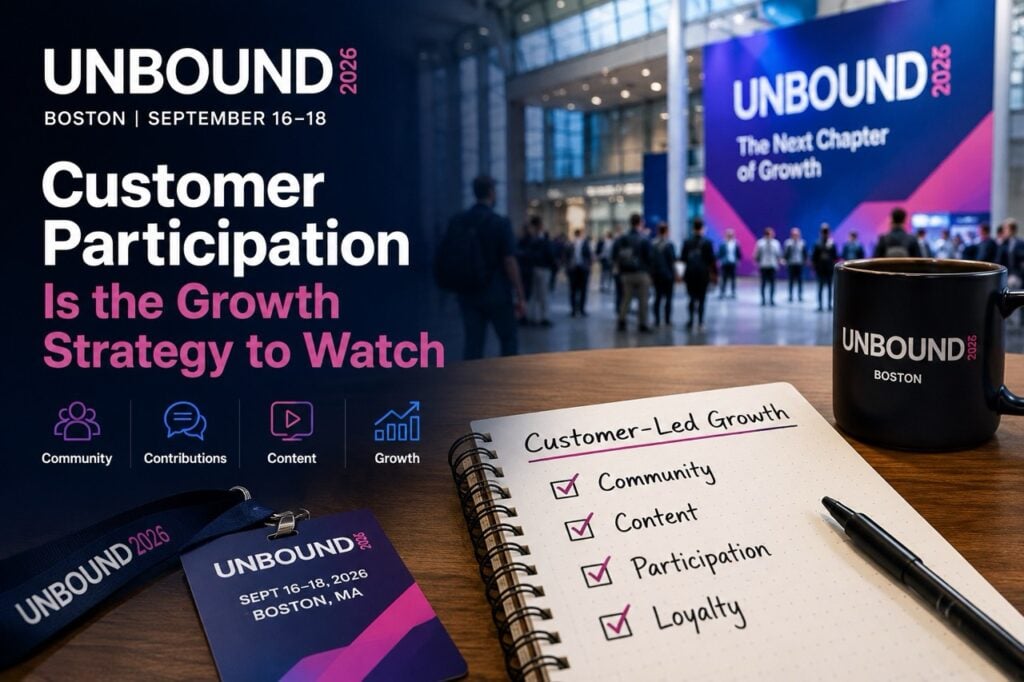
UNBOUND 2026 will offer marketers hundreds of ideas for generating more traffic, content, leads, and efficiency.
The harder question is what will still create growth when everyone gains access to the same AI tools.
The answer may be customer participation. As content production becomes faster and search traffic becomes less dependable, brands need assets competitors cannot reproduce with another prompt. Real customer experiences, questions, stories, recommendations, and use cases meet that test.
That is the theme attendees should watch across UNBOUND 2026. The strongest growth ideas will not treat customers as the end of a funnel. They will give customers an active role in what the brand learns, creates, and shares.
What UNBOUND 2026 Is Signaling About Growth
UNBOUND 2026 takes place September 16–18 in Boston. Formerly known as INBOUND, the event now positions itself around moving beyond outdated growth playbooks.
The current program includes more than 200 sessions covering AI adoption, go-to-market strategy, leadership, customer experience, content marketing, and growth. A new community format called The Exchanges will also connect attendees around shared roles, industries, and identities.
The agenda reflects a clear shift. Marketers still need acquisition. But acquisition alone is becoming a weaker foundation for sustainable growth.
One UNBOUND session examines how marketers can adapt to zero-click search. Another asks whether B2B teams have become too obsessed with the funnel. Sessions on customer onboarding, loyalty, community, and retention all point in the same direction.
Growth is moving beyond the first conversion. That creates an important question for attendees: what can marketing build with customers after they arrive?
Search Traffic Is Becoming Less Dependable
AI search is changing how people discover information.
Pew Research Center found that users clicked traditional search results in 8% of visits when a Google AI summary appeared. Without an AI summary, the click rate was 15%.
That does not make search irrelevant. It makes undifferentiated content less dependable. If an AI system can summarize ten similar articles, producing an eleventh version creates little advantage. Brands need original evidence and experience that did not exist before.
Customers can provide both. A customer explaining an unexpected use case creates new information. A community answering a focused question reveals language the marketing team may not use. A collection of customer stories can expose patterns across industries, regions, or buying situations.
This is more than social proof. It is an original content source. BrandLens has previously explained why audience-driven storytelling gives customers a meaningful role in the brand narrative. At UNBOUND, attendees should look for strategies that extend that idea across the customer journey.
Customer Participation Changes the Growth Model
Most marketing funnels place the customer at the end.
The person discovers the brand, evaluates the offer, converts, and moves into a separate retention process. Marketing then returns to the top of the funnel to find someone new.
Customer participation creates a loop instead. A customer contributes an experience, question, idea, story, or recommendation. That contribution helps another prospect understand the brand. It may also improve onboarding, inform product decisions, or give the community something worth discussing.
The original customer is no longer only a conversion. They become a contributor. This idea appears directly in the UNBOUND agenda. A session on turning users into lifelong customers will examine how Pexels redesigned creator onboarding, grew its community beyond 300,000 members, and built a library containing more than three million photos and videos.
The important lesson is not that every brand should copy Pexels. It is that onboarding can introduce contribution, not just consumption.
Community-Led Growth Needs More Than a Community Space
UNBOUND’s new Exchanges format reflects growing interest in smaller, more relevant professional communities.
Brands face a similar challenge. Launching a forum, group, or channel does not automatically create community-led growth. A space can exist without giving members anything meaningful to do.
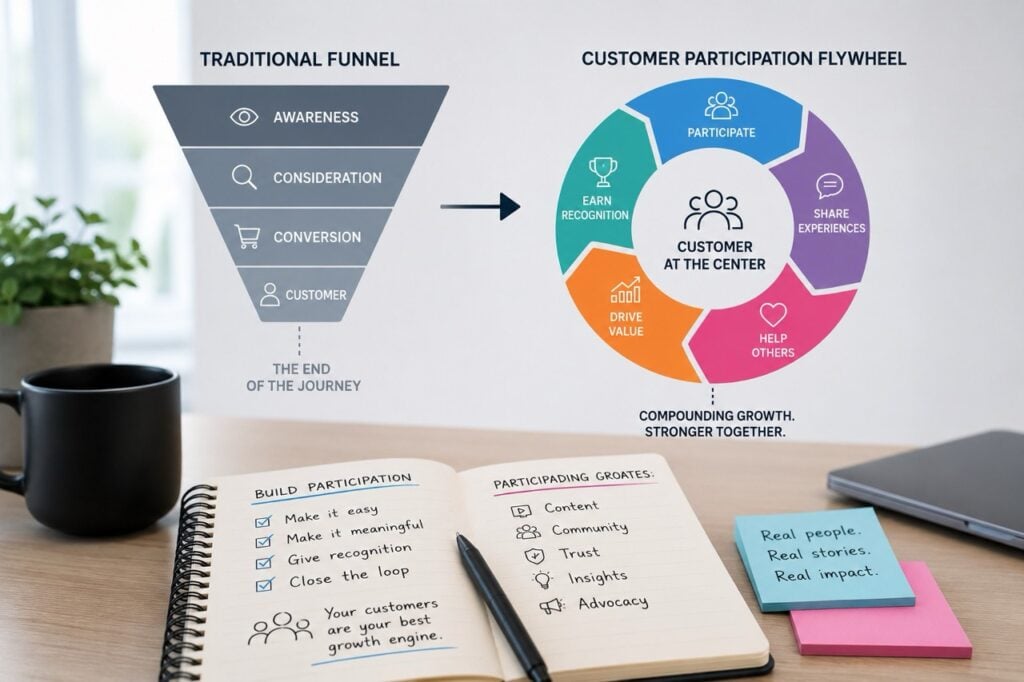
McKinsey’s community flywheel framework argues that brands can build engagement and loyalty by participating in communities. The operative word is participating.
Healthy communities create exchanges between members and the organization. People contribute knowledge, experiences, reactions, and support. The value does not flow in only one direction.
User-generated content can make that exchange visible. It can surface member expertise, celebrate customer progress, document shared experiences, and give participants recognition. It also creates an owned record of what the community values.
Without contribution, a branded community can become another distribution list.
Campaign Content and Compounding Content Are Different
Marketers should listen carefully when UNBOUND speakers describe successful content programs.
Did the campaign produce a temporary spike, or did it create an asset that becomes more valuable over time?
Campaign content supports a defined moment. It may launch a product, promote an event, or respond to a trend. Its value often declines when the campaign ends.
Compounding content works differently. Each contribution strengthens a growing library of customer language, experiences, objections, and use cases. The organization can learn from the collection and improve future prompts. New customers can also see how people like them describe the experience.
That does not mean asking customers for content constantly.
It means identifying repeatable moments when participation feels natural. These might include onboarding milestones, product outcomes, renewals, community events, support resolutions, or new use cases.
The operational challenge is turning those moments into a consistent process. Brands need a method for collecting user-generated content at scale without relying on scattered posts and one-off requests.
AI Should Support Participation, Not Replace It
AI will dominate much of the UNBOUND 2026 conversation. That is appropriate.
AI can help teams organize customer contributions, identify themes, summarize feedback, create transcripts, suggest prompts, and prepare content for different channels.
Those uses make participation easier to manage. They do not replace the participant. The distinction matters because customer contribution carries information about a real experience. Synthetic output may reproduce the format, tone, or appearance of that experience. It cannot honestly reproduce its origin.
Marketers should therefore assess AI ideas based on where human input remains in the system.
Does the technology help the team hear more customers? Does it make useful contributions easier to find? Does it reduce repetitive work around a growing content library?
Those are stronger questions than asking how many assets the tool can produce.
What to Prioritize at UNBOUND 2026
Attendees interested in durable growth should prioritize four types of sessions:
- AI search and zero-click discovery: Look for strategies built around original information, tools, evidence, and experience.
- Customer retention and loyalty: Ask how marketing can create value after acquisition rather than handing customers to another department.
- Community and customer experience: Focus on models that invite contribution, not just membership or passive consumption.
- Content operations: Look for systems that turn recurring customer input into an organized, reusable resource.
For each idea, ask one practical question:
Does this strategy become stronger as more customers participate?
If the answer is yes, the idea may compound. If the answer is no, it may simply create another campaign the team must rebuild next quarter.
The Growth Opportunity After UNBOUND 2026
UNBOUND will generate plenty of new playbooks. Some will improve acquisition. Others will make teams faster.
Both outcomes matter. But the more defensible opportunity sits beyond output and traffic. Brands can create growth systems in which customers contribute the evidence, language, stories, and insights that improve the next customer’s experience.
That is customer-led growth in a practical form. It also creates something AI cannot commoditize easily: a continuing record of real people choosing to participate.
Organizations building that capability are beginning to use guided UGC systems that turn recurring customer participation into an owned content resource, rather than starting every request and campaign from zero.