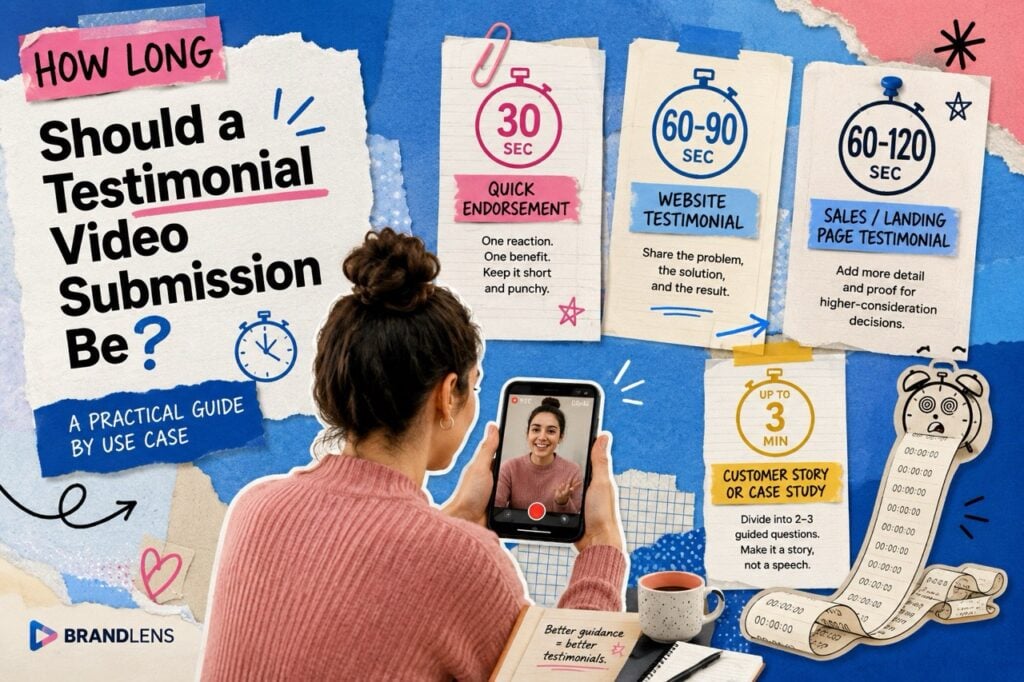
That is enough time to share a specific experience without forcing the customer to deliver a speech. More complex customer stories may need up to three minutes, but they should be divided into shorter responses.
The right limit is not determined by what the recording tool allows. It is determined by what you need the customer to say.
How Long Should a Testimonial Video Submission Be?
For most customer testimonials, aim for a response between 45 and 90 seconds.
A quick endorsement may take only 20 to 45 seconds. A more detailed result story may need up to two minutes. Case-study submissions can run longer, but asking for one uninterrupted three-minute recording is rarely the best approach.
The strongest rule is simple:
One focused answer is usually more useful than one long testimonial.
Customers are not professional presenters. Give them a broad prompt and three minutes of recording time, and many will repeat themselves, wander into irrelevant details, or become unsure about when to stop.
Length matters, but structure matters more. For a broader look at the collection process, see this guide to requesting video testimonials from customers.
Submission Length Is Not Published Video Length
Teams often treat three different measurements as though they are the same:
- Maximum recording time: How long the customer is allowed to record.
- Expected response time: How long you ask the customer to speak.
- Published video length: How much of the submission the audience eventually sees.
Those numbers do not need to match.
You might allow a customer 90 seconds, ask them to aim for one minute, and publish a 35-second edit. The extra recording time gives the customer room to speak naturally. The final edit removes pauses, repetition, and unnecessary setup.
Do not use your platform’s technical maximum as creative guidance. A five-minute recording limit does not mean customers should be asked to fill five minutes.
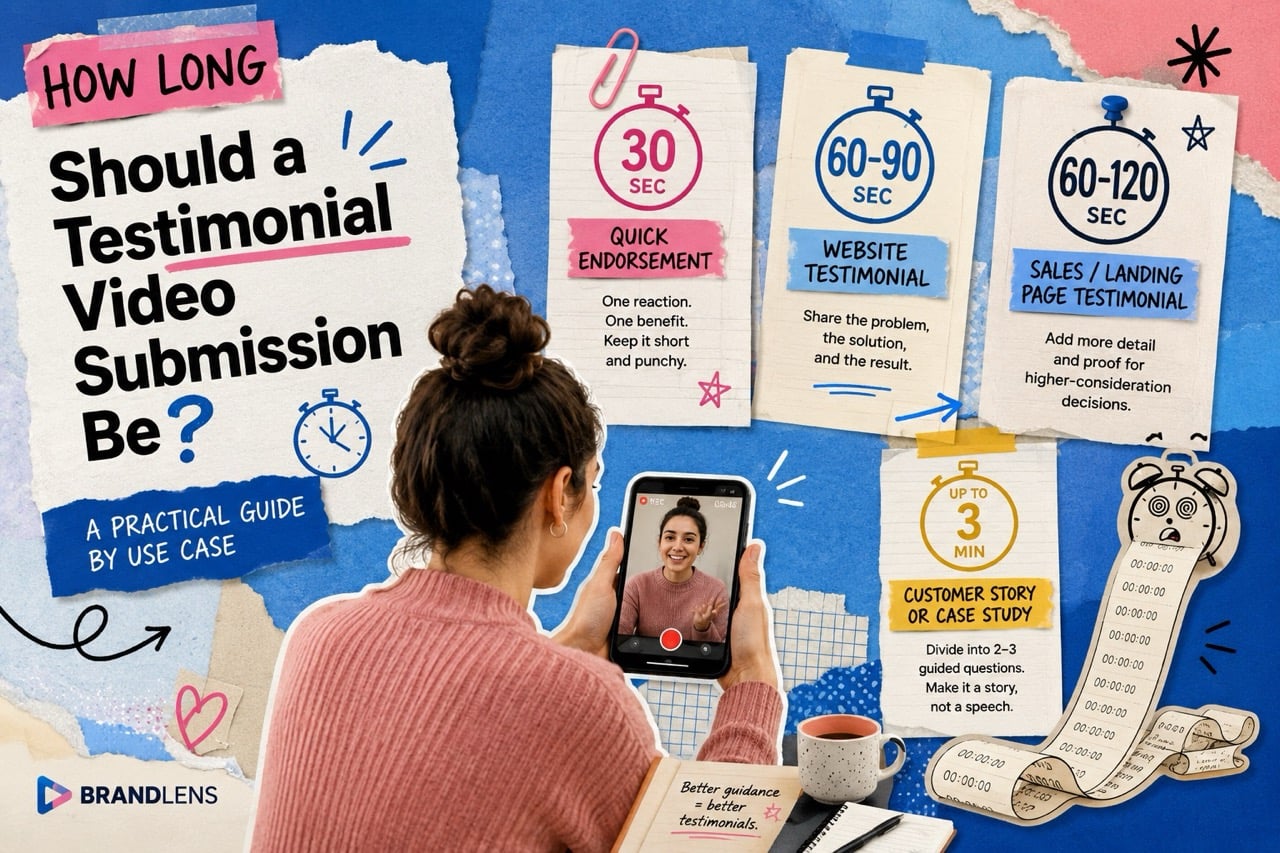
Testimonial Video Submission Length by Use Case
1. Quick Endorsement: 20–45 Seconds
This length works when you need one reaction, benefit, or recommendation.
Use it for social clips, event reactions, product-page highlights, or short customer quotes. Ask one narrow question, such as:
“What is the biggest difference this product made for you?”
The customer does not need to explain the entire relationship. They need to make one credible point.
Shorter submissions also create more options for distribution. For example, Google recommends 10–30-second vertical videos for action-oriented YouTube Shorts ads. A concise testimonial response is easier to adapt into that type of placement.
2. Website Testimonial: 45–90 Seconds
This is the best range for most homepage, product-page, and service-page testimonials.
It gives the customer enough time to establish context, describe one problem, and explain what changed. The response can feel complete without becoming a miniature case study.
A useful prompt sequence might be:
- What problem were you trying to solve?
- What changed after using the product or service?
- What result stands out most?
Do not expect a customer to answer all three well in one open-ended recording. Choose the most important question, or present the questions as separate clips.
3. Sales or Landing-Page Testimonial: 60–120 Seconds
A higher-consideration purchase may justify a longer response.
This range works for sales follow-ups, proposals, landing pages, and testimonials that address a specific buyer concern. The extra time should add evidence, not background.
Ask the customer to explain a meaningful challenge, the change they experienced, and one concrete outcome. Avoid long company introductions or general praise.
“They were great to work with” is positive, but not very useful. “We reduced the review process from several days to one afternoon” gives the audience something to evaluate.
4. Customer Story or Case Study: Up to Three Minutes
Complex stories sometimes need more room. This is common in B2B, education, healthcare, nonprofit work, and services with longer customer journeys.
But three minutes should be the total submission length, not one continuous monologue.
Divide the story into two or three guided recordings:
- What was happening before?
- What changed during the experience?
- What result or moment mattered most?
This produces cleaner answers and reduces pressure on the participant. It also gives the marketing team separate clips that can be edited, reordered, or published independently.
A generic upload form cannot provide much direction once the customer starts recording. A guided video submission platform that presents prompts during the recording experience can structure the story before the footage reaches the content team.
Better Prompts Matter More Than Extra Time
A weak question can make 30 seconds feel long. A focused question can make 90 seconds useful.
Avoid prompts such as:
“Tell us about your experience.”
That question gives the customer too many possible directions. Some will describe the company. Others will explain how they discovered the product. A few may reach the result you actually wanted.
Ask for one part of the story instead:
- What nearly stopped you from choosing us?
- What surprised you after getting started?
- What can you do now that you could not do before?
- What would you tell someone considering the same decision?
Specific prompts produce specific testimonials.
They also help keep claims credible. The FTC’s guidance on endorsements and testimonials emphasizes that endorsements must be honest and not misleading. Customers should describe their real experiences in their own words, without being pushed toward a predetermined claim.
How to Set a Time Limit Without Rushing the Customer
Tell participants what you expect before they begin. “Aim for about 60 seconds” is more helpful than displaying a silent two-minute countdown.
Then make the recording experience forgiving:
- Show one prompt at a time.
- Allow the customer to review and retry.
- Explain how the video may be edited or used.
- Keep instructions visible while they record.
The goal is not to make customers speak faster. It is to remove the uncertainty that makes recording feel difficult.
The Best Testimonial Is Long Enough to Be Specific
There is no universal testimonial video length. There is only the right amount of time for the answer you need.
Use 20–45 seconds for one reaction. Use 45–90 seconds for a standard customer testimonial. Allow up to two minutes for a detailed sales story. Reserve longer submissions for structured, multi-question case studies.
Most importantly, do not ask customers to create the story structure themselves.
Organizations that need consistent testimonials are moving toward guided video submission workflows with prompts built into the recording experience. Better guidance creates shorter recordings, clearer answers, and footage that is easier to use.