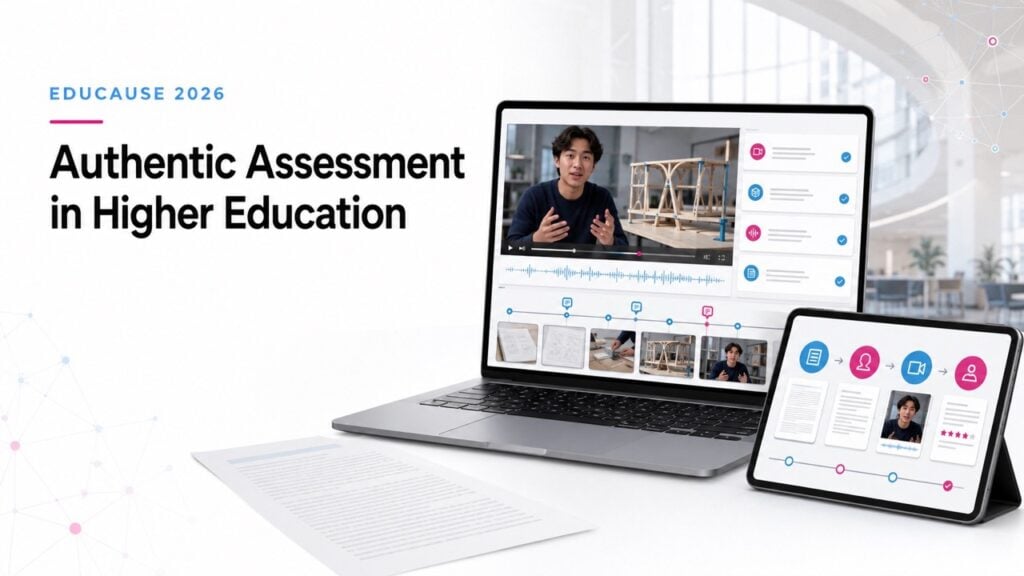
As higher education leaders prepare for EDUCAUSE 2026, the most important artificial intelligence conversation may not concern which model a campus should license. It may concern whether institutions can still tell what students have learned. The rise of authentic assessment in higher education reflects a growing weakness in traditional assessment design. Essays, reports, code, and polished presentations once served as reasonable proxies for student understanding, but generative AI can now produce many of those outputs without revealing how much intellectual work the student performed.
The answer is not a more aggressive technological dragnet. Institutions need assessment models that make reasoning, application, revision, and judgment easier to see, while giving faculty practical ways to collect and evaluate that evidence.
Why Authentic Assessment in Higher Education Is Moving Up the Agenda
The 2026 EDUCAUSE Horizon Report on teaching and learning identifies AI’s effect on assessment as one of the shifts shaping higher education. The report points toward more authentic, process-based demonstrations of learning as conventional assignments become harder to interpret.
A separate EDUCAUSE report on AI and learning assessment surveyed 438 faculty and staff members involved in assessment. Most respondents reported using AI when creating or administering assessments, while most also believed students were using AI when completing them. AI is already inside the assessment process. The unresolved question is whether an assignment still produces valid evidence of the learning outcome it was designed to measure.
Authentic assessment does not simply mean assigning a project that resembles a workplace task. A recent scoping review of authentic assessment research found that authenticity can come from professional context, personal relevance, digital practice, student agency, cognitive challenge, and social collaboration.
A clinical student might explain a treatment decision, while an engineering student could defend a design choice. A business student might present recommendations based on an unfamiliar scenario and respond to questions that test the reasoning behind the final answer.
AI Detection Cannot Carry Assessment Integrity
An institution that responds to generative AI only by buying a better detector is solving the wrong problem. Even Turnitin states that its AI writing report can misidentify both human and AI-generated writing and should not be used as the sole basis for adverse action against a student.
The company’s own guidance for using AI writing reports calls for further review, human judgment, and alignment with institutional policy. Detection may provide a signal, but it cannot independently establish whether meaningful learning occurred. That distinction matters because academic integrity and assessment validity are related but different problems. A faculty member may be unable to prove exactly how AI was used while still having insufficient evidence that a student understands the submitted work.
The more useful question is not simply, “Did AI produce this?” It is, “Can the student explain, apply, evaluate, and defend what was submitted?”
Authentic Assessment in Higher Education Must Make Thinking Visible
An assessment should not become a surveillance exercise. It should produce enough evidence for faculty to make a sound academic judgment about a student’s knowledge, decisions, and ability to apply what they have learned. A UNESCO IdeasLAB analysis of assessment in the AI age argues for placing more value on the learning process. Suggested approaches include staged submissions, process journals, peer review, recorded think-aloud exercises, oral explanations, and opportunities for students to defend their conclusions.
These formats reveal more than a finished artifact can show. They help faculty see how students evaluate evidence, respond to feedback, revise assumptions, and develop an answer over time.
Video can support this shift, but video alone does not make an assessment authentic. A student can read an AI-generated script into a camera just as easily as they can paste the same text into a document.
The value comes from the assessment design. A short project walk-through, skills demonstration, oral reflection, or response to a specific scenario can expose reasoning that a finished paper hides, especially when the prompt asks students to explain a decision or identify how their thinking changed.
Better Assessment Creates a Technology and Workflow Challenge
More meaningful evidence often creates more complicated workflows. Faculty may need to receive staged drafts, portfolios, audio explanations, demonstrations, short recordings, or several components connected to the same assignment. That complexity quickly becomes administrative work when the submission process was designed only for documents. Large recordings arrive through email, videos sit in shared drives, and instructors manually connect each file to the right student, prompt, rubric, and review status.
This is the same operational weakness explored in BrandLens’ analysis of why upload-and-folder workflows break down for video submissions. Receiving a media file is not the same as operating a complete submission process.
For student work, the institution may need the course, assignment, prompt, student identity, submission status, accessibility requirements, and retention policy to remain connected. Privacy, accommodations, authorized access, and deletion rules also need to be addressed before a new assessment format is adopted.
A Jisc review of assessment trends in higher education identifies growing interest in capstone assessments, oral and investigatory vivas, portfolios, process-focused assessment, and digital submission at scale. The report also argues that institutions need stronger digital infrastructure to support assessment redesign across programs rather than through isolated experiments.
The Technology Should Support the Assessment, Not Define It
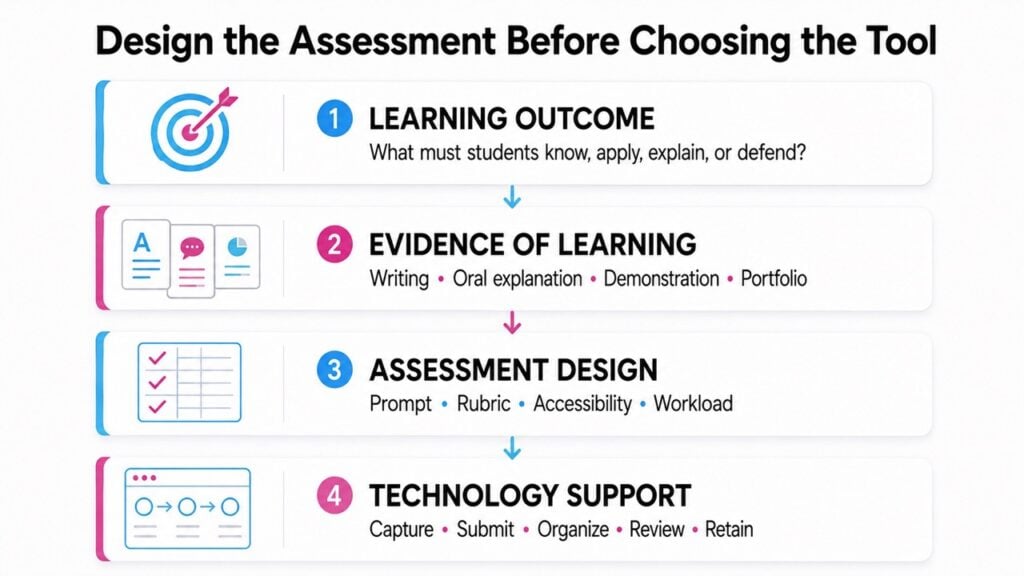
Higher education technology leaders should resist starting with a product category. The first question is which learning outcomes have become difficult to verify through the institution’s current assessment methods.
Some outcomes may still be measured effectively through written work. Other methods may benefit from staged evidence. An oral defense, a practical demonstration, or a reflection can explain the decisions behind a final result.
Institutions must then account for faculty workload and student equity. A sound assessment model will fail if it doubles grading time, introduces unnecessary technical barriers, or ignores accessibility and accommodation requirements.
Clear prompts, reasonable recording limits, common rubrics, alternative formats, and defined retention policies can make richer evidence manageable. Technology should reduce friction around capture, submission, organization, and review without deciding what academic quality looks like.
Browser-based recording can be useful when an institution needs to collect video submissions without upload chaos. Students can open a link, respond to specific prompts, record in the browser, and submit without transferring a large file through email or a shared folder.
That capability does not replace the learning management system, grade-book, assessment rubric, or faculty judgment. It solves a narrower problem by making short explanations and demonstrations easier to receive and organize.
The Lasting Question Behind EDUCAUSE 2026
EDUCAUSE 2026 will include extensive discussion of AI platforms, governance, infrastructure, data, and institutional strategy. The more durable issue is whether higher education protects weak assessments with stronger monitoring or redesigns assessment around better evidence of learning.
No assessment will be completely resistant to AI, and that should not be the goal. Institutions should instead make learning visible enough for faculty to evaluate it with confidence while teaching students how to use AI responsibly.
Written work will remain important, but it will increasingly be supplemented by oral explanations, portfolios, demonstrations, staged projects, and student video submissions where those formats match the learning outcome. The strongest assessment systems will combine thoughtful pedagogy with workflows that faculty and students can realistically use.
Institutions exploring those formats will need technology that reduces submission friction without dictating assessment practice. Browser-based video submission workflows can support the capture and organization layer, while academic leaders retain control over learning outcomes, accessibility, policy, standards, and evaluation.