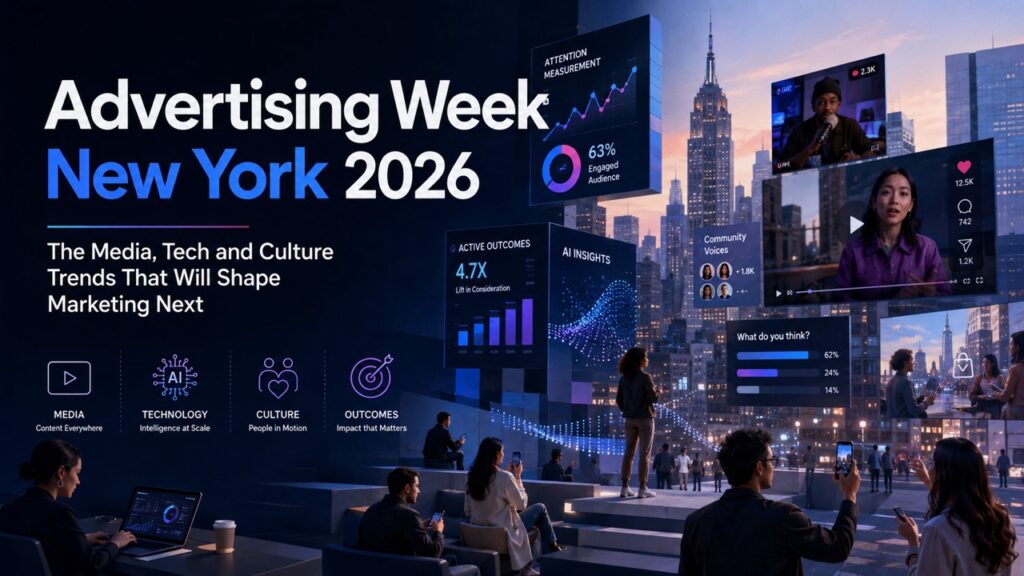
Marketing does not have a shortage of new tools, channels or content. It has a harder problem: deciding which changes actually matter. That will be the useful question hanging over Advertising Week 2026, taking place October 5–8 in Manhattan’s Penn District.
The conference is bringing together brand leaders, agencies, media executives, creators and technology teams across programming focused on media transformation, AI, creator influence, audience engagement and brand growth. The individual topics are broad. The bigger signal is much clearer: media, technology and culture are becoming harder to separate, and marketers need operating models that reflect that reality.
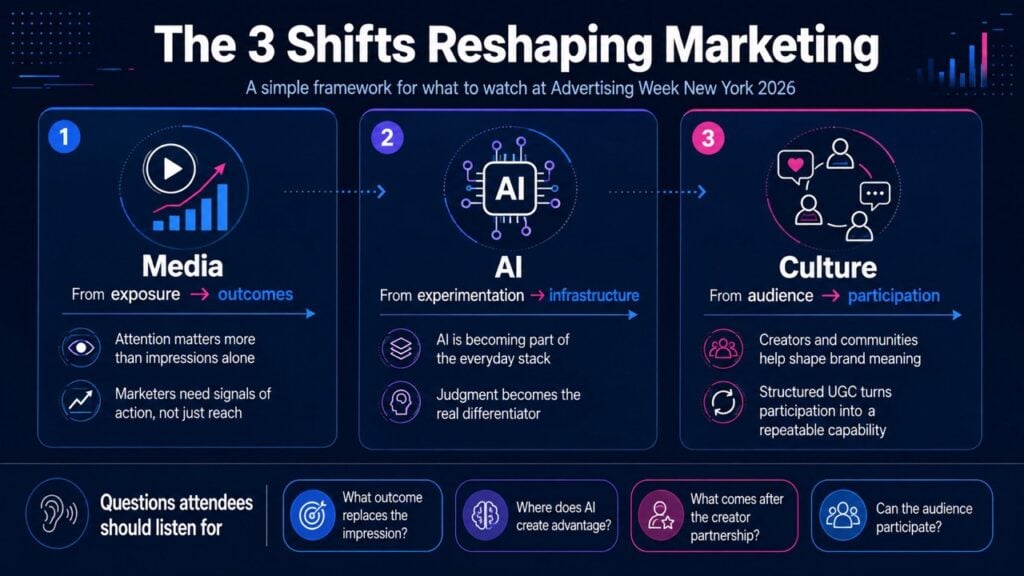
Three shifts deserve particular attention. Media is moving from exposure toward outcomes. AI is moving from experimentation toward infrastructure. Culture is moving from audiences watching brands toward people actively shaping what brands become.
Media trends to watch at Advertising Week New York 2026
The media conversation in 2026 is increasingly about what happens after an impression. Reach still matters, but reach without a meaningful outcome is becoming harder to defend. Advertising Week’s own program reflects that shift, with tracks dedicated to the attention economy, streaming, modern marketing and measurement, commerce media and audience engagement.
The numbers reinforce it. IAB’s 2026 Outlook Study forecasts U.S. ad spending to grow 9.5% this year, with social media, connected TV and commerce media all growing faster than the broader market. Digital video spending alone is expected to pass $80 billion in 2026.
More spending does not make media simpler. It raises expectations. Marketers increasingly need to explain not only where an audience was reached, but what that audience noticed, remembered, did or contributed afterward.
That makes the Attention Economy track particularly interesting. The industry has spent years optimizing delivery metrics. Now attention itself is becoming more structured, with measurement frameworks emerging around the difference between an ad being available to see and a person actually engaging with it.
For attendees, the practical question is not whether a new attention metric will replace impressions. It probably should not. The more useful question is whether your media plan creates any reason for a person to do something beyond receiving the message.
AI marketing is becoming infrastructure, not the idea
Advertising Week has dedicated significant space to AI and innovation, data, adtech and the technology stack of tomorrow. That makes sense. IAB research found that five of marketers’ six leading focus areas for 2026 involve AI, while adoption is shifting from experimentation toward scaled execution.
The interesting part is what happens after AI stops feeling new. When every marketing organization can generate variations, summarize research, optimize media and accelerate production, access to AI stops being much of an advantage. Judgment becomes the advantage.
Marketers should listen carefully for where speakers draw that line. Which decisions should become automated? Which require human taste, context or accountability? Where is AI improving an existing process, and where is it simply creating more output?
That distinction matters especially in content. AI can produce convincing images, copy and video at extraordinary speed. It cannot manufacture the fact that a real customer, fan or community member chose to participate. That is why AI-generated content and user-generated content solve fundamentally different problems.
The point is not that brands should choose human content over AI. That would be an artificial choice. The better strategy is to use automation aggressively where it removes low-value work while protecting the human signals that make marketing believable.
Culture is becoming something brands participate in, not control
The culture side of Advertising Week may offer the clearest view of where marketing is heading. Confirmed programming includes Creator Perspectives, Content & Pop Culture, the New Sports Economy and a Gaming Summit. Announced speakers also span professional sports, entertainment, consumer brands and creator-led media.
That mix matters because creators are no longer sitting at the edge of media strategy. IAB projected U.S. creator advertising spend to reach $44 billion in 2026. At the same time, the industry is still working through fragmented measurement, inconsistent reporting and the challenge of comparing creator activity with established media channels.
Brands therefore need to think beyond simply hiring more creators. Paid creator partnerships can provide reach, credibility and production talent. But there is a much larger group sitting outside the creator marketplace: customers, fans and community members who already have a relationship with the brand.
This is where UGC strategy becomes more interesting. The goal should not be to wait for random posts and hope something usable appears. Nor should brands turn customers into unpaid actors reading rigid scripts. The better model is structured participation: give people a clear reason to contribute, enough guidance to make participation easy, and enough freedom for their individual voice to remain visible.
That approach also changes the economics of content. Instead of treating every piece as a new production project, brands can create repeatable systems for gathering customer stories, reactions, product experiences and community perspectives. The difficult part is rarely convincing people that they can record a video. It is learning how to collect user-generated content at scale without creating operational chaos.
What attendees should listen for at Advertising Week New York 2026
With hundreds of conversations competing for attention, attendees will get more value by arriving with questions than by chasing every trend. Four questions can help separate durable changes from conference noise.
- What outcome replaces the impression? Look for examples connecting media and creative decisions to actual behavior, not just larger reporting dashboards.
- Where does AI create an advantage after everyone has AI? Pay attention to workflow design, judgment, data and differentiation rather than another demonstration of content generation.
- What comes after the creator partnership? The creator economy is becoming a serious media channel. The next challenge is building relationships with the broader communities surrounding those creators and brands.
- Can the audience participate? When someone watches, attends, buys or follows, ask whether the experience gives that person a meaningful way to respond, contribute or create.
That final question may become increasingly important. Marketing has spent decades becoming better at targeting people. The next advantage may come from becoming better at involving them.
The trend behind the trends
Advertising Week New York 2026 will undoubtedly produce new terminology, platform announcements and predictions. Some will matter. Many will disappear before next year’s conference.
The more durable change sits underneath them. Media is becoming more accountable. Technology is becoming more automated. Culture is becoming more participatory. Those three forces are pushing marketers toward a model where people are not simply endpoints for campaigns.
The brands that win the next cycle will not be the ones that publish the most content. They will be the ones that create the most meaningful reasons for people to respond. That may happen through creators, communities, customer stories, social video or other forms that have not fully emerged yet.
For marketing teams building around that shift, the operational question is how to make participation repeatable without stripping away what makes it human. That is why guided UGC collection systems that combine participation with structure are becoming increasingly relevant as audience-created media moves from occasional campaign tactic to ongoing marketing capability.