Most event previews expire before the lanyards come off. Leaders Week London 2026 should be more useful than that. The event runs 7–8 October at Stamford Bridge, with the sports business world gathering around some unusually big questions. The Leaders Week London 2026 agenda covers AI, fan identity, sponsorship, storytelling, women’s sport, media, and live experiences. My read is that these are not separate conversations. They point toward the same larger shift.
Sports organisations are getting better at reaching fans. The harder question is how they get fans to actually participate. That difference matters, because another impression is easy to buy. Genuine involvement is harder.
Why Leaders Week London 2026 is really about the fan relationship
Look across the agenda and “fan engagement” appears almost everywhere, even when the session uses different language. Alexis Ohanian will discuss community and fandom. Tottenham Hotspur will examine the connected fan experience. The Fan Identity Forum goes further, asking how organisations can know and understand every fan.
This makes sense. Sport has more audience data than it did ten years ago. It also has more channels, more apps, more content, and more competition for attention.
Deloitte’s 2026 Digital Media Trends research found that 55% of fans engage with their interests across multiple platforms. That rises to about 70% among Gen Z and millennial fans. Almost half also seek fandom content from creators or their fan communities.
The fan journey is clearly getting wider. But wider does not automatically mean deeper. A CRM record can tell you who a fan is. It cannot give that fan a reason to do something.
That distinction gets missed. We have argued before that experiences matter more than impressions when fans become part of the story. The idea becomes even more relevant when attention is fragmented across six different places.
For every new fan experience, I think teams should ask three very basic questions. They sound almost too simple, which is probably why they get skipped.
- What can the fan actually do, beyond watching or clicking?
- Does the interaction feel worth their time?
- Does anything meaningful happen after they participate?
PwC describes digital fan engagement as the front door to fandom. I agree, but the front door still needs somewhere interesting to lead. Connecting systems is useful. Designing better reasons to participate is the next job.
AI will scale content. It cannot manufacture fandom.
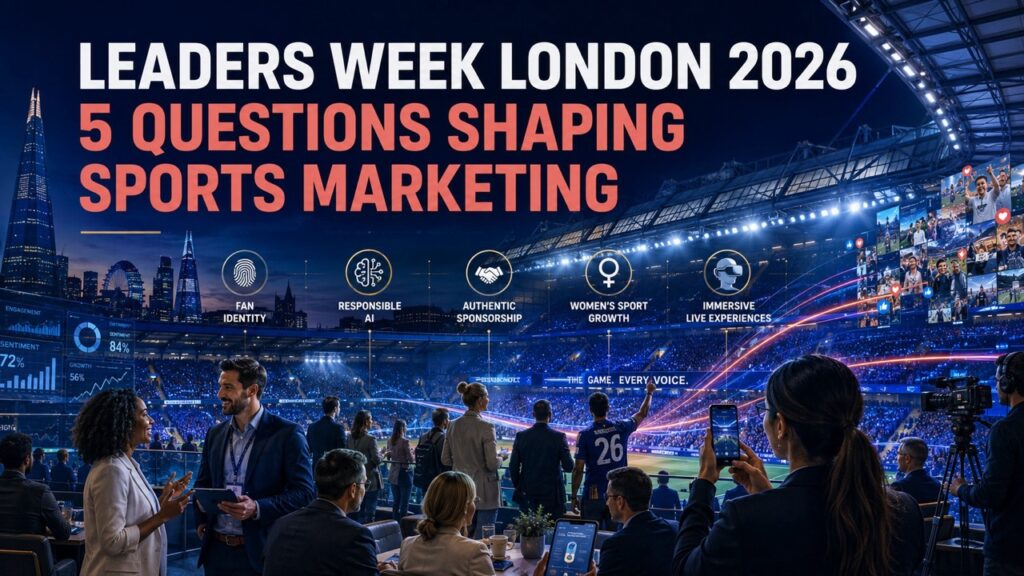
AI may be the most visible technology topic at Leaders Week London 2026. The CMO discussion includes it. Microsoft executives will address AI directly. NASCAR will discuss its use in content and fan relationships.
The adoption numbers explain why. In a 2026 survey of 675 sports media executives, Stats Perform found that 81% had expanded AI use during the prior year. Seven in ten said AI already helps their organisations do more in less time.
This is not an experimental technology anymore. The more interesting question is where it should sit. I think sport will get the most value when AI becomes less visible.
Use it to search footage, personalise feeds, translate content, analyse data, and speed production. Use it behind the scenes. There are plenty of useful jobs for it.
But AI-generated enthusiasm is not fandom. A model can produce a celebration video that looks convincing. It cannot have waited twenty years for the club to win.
That distinction gets more valuable as synthetic media improves. Deloitte’s 2026 UK consumer research also found greater comfort with AI in operational tasks than creative development. Audiences may accept automation without wanting human expression automated away.
The sports industry should take advantage of AI aggressively. It should also know what not to automate. The original signal of fandom still has to come from a person.
The live event is becoming a participation surface
One of the more interesting Leaders sessions has Formula 1 discussing how races became bigger city events. The agenda explicitly mentions concerts, food, brand showcases, and the “festivalisation” of sport. That is not a side trend.
A stadium or fan zone is no longer just a place where the product happens. It is also a media environment. Every queue, screen, concourse, hospitality space, and sponsor footprint can become part of the experience.
This is where I think sports marketing sometimes overcomplicates things. A fan already has a camera, an internet connection, and a reason to care. The missing part is often a good invitation.
QR is still treated like a utility. Scan for the menu. Scan for tickets. Scan for information. In live sport, it can be much more useful as an activation trigger.
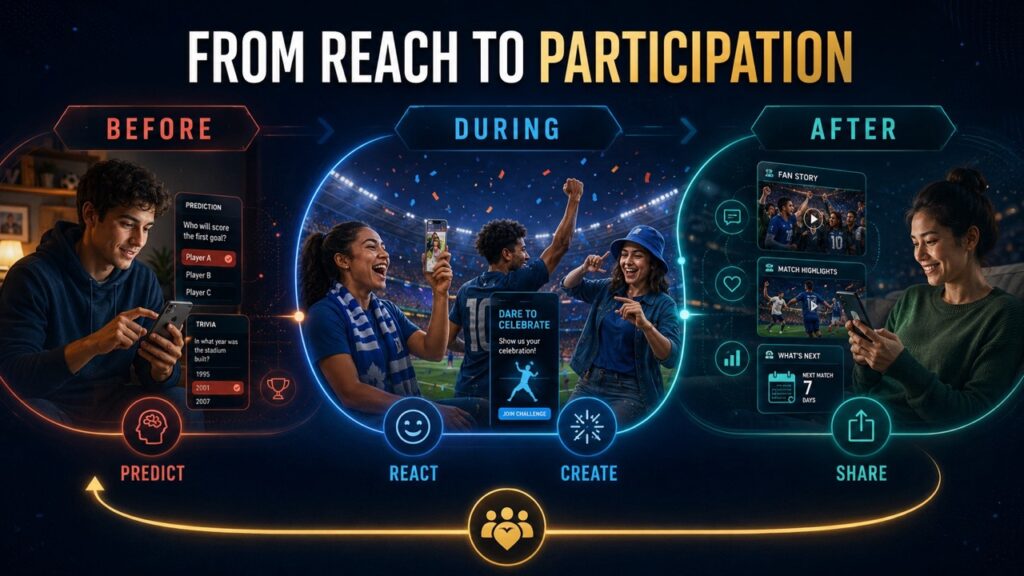
A simple activation can create different participation moments around the same event:
- Before: predictions, player picks, rituals, or “show us how you are arriving” challenges.
- During: reactions, branded challenges, commentary, trivia, or sponsor-led creative moments.
- After: celebrations, instant reactions, favourite moments, or “what happens next?” predictions.
The key is reducing the distance between seeing the invitation and joining it. Nobody should need another download just to record a ten-second reaction.
This is one place BrandLens fits naturally. Guided, app-free sports video activations accessed through a link or QR code can turn a physical moment into fan action. The technology should stay in the background while the fan gets the interesting part.
Leaders also has a session called “Beyond the Turnstile,” focused on connected experiences inside and outside venues. That wording is right. The strongest sports experiences should not begin at kickoff or end at the exit gate.
Women’s sport is building a different commercial playbook
Women’s sport is not a side room on the Leaders agenda. Jessica Berman and Nikki Doucet will discuss the growth of the NWSL and WSL. Ally will unpack its 50/50 media investment pledge. GWI will examine sponsorship around the FIFA Women’s World Cup.
The numbers now support the attention. Deloitte expects women’s elite sports revenues to reach at least $3 billion in 2026. That would be a 25% increase from 2025.
Commercial revenue is expected to represent 45% of the total. So the next phase is not simply about adding audience. It is about how those audiences are understood, activated, and valued.
There is also an opportunity here that mature sports properties do not always have. Women’s leagues can build modern fan behaviour from the beginning. They do not have to inherit every old sponsorship habit.
That means teams and partners can test different ideas around participation:
- Make athletes and fans part of the same story, rather than separate content streams.
- Build local rituals while leagues and clubs are still forming their identities.
- Design sponsor activations around involvement instead of logo placement.
- Give younger fans formats they naturally want to share with other fans.
Copying the men’s game would actually waste some of the opportunity. A fast-growing category gets to decide which legacy practices are worth keeping. It also gets to leave some behind.
Sponsors need proof of involvement, not more logo exposure
The sponsorship tension is especially clear this year. Stats Perform found that 70% of surveyed executives say sponsors demand more digital content. More than one-third still struggle to connect sponsors with sport in an authentic way.
That gap is important. Sponsors do not need another place to put the logo. Sports properties do not need another piece of content nobody asked for.
The better question is whether the sponsor improves the experience. If removing the sponsor makes the activation better, the idea probably needs more work.
This also changes measurement. Impressions still matter, but they describe exposure. A participation-led sports sponsorship activation can produce stronger behavioural signals.
- How many fans started the experience?
- How many completed it?
- How long did they interact?
- How many chose to share the result?
- Did the activation create another action afterward?
These are not perfect metrics either. But they tell us more than counting how many people may have walked past signage. The sponsor becomes part of something the fan did.
This is why the Leaders sessions around cultural relevance are worth watching closely. Vans, lululemon, LEGO, Dude Perfect, F1, and others all appear in different conversations. The common problem is not visibility. It is earning a place in culture without looking like you bought the seat.
What to take from Leaders Week London 2026 after October
The most useful outcome from Leaders Week London 2026 will not be a list of technologies to buy. It will be a clearer definition of what engagement now means. That definition is already moving beyond views, reach, and even personalisation.
AI will make content cheaper to produce. Better data will make fans easier to identify. Connected systems will make experiences easier to personalise. Those improvements are real, but none guarantee that a fan will care more.
The harder work is designing something worth joining. That might be a live challenge, a prediction, a fan ritual, a creative response, or a moment someone wants to share with friends. Small interactions can carry more emotional value than another polished campaign.
For organisations exploring that layer, BrandLens supports browser-based creative video activations with guided prompts, branded scenes, QR access, and participant sharing. It is one practical example of making participation part of the experience itself. The fan should remember what they did, not the software behind it.
That is the conversation I would carry into Stamford Bridge, and also out of it. Sport does not have an engagement shortage. It has a participation design problem.