Brandweek 2026 will give marketers no shortage of ideas about artificial intelligence. The harder task will be deciding which ideas deserve attention after the event ends.
AI can produce more assets, shorten workflows, and support personalization. Those capabilities matter. Yet more content does not automatically create more customer involvement, greater trust, or a stronger brand.
That is the tension attendees should carry into Brandweek 2026.
The most useful sessions will not simply show what AI can generate. They will explain how technology improves a real customer relationship or removes a meaningful business constraint. Everything else risks becoming an impressive demonstration without a durable marketing advantage.
Attendees need a filter.
These five questions can help marketing leaders assess AI, user-generated content, and participation claims throughout the conference. They are designed for session notes, vendor conversations, and the internal meetings that follow.
What Brandweek 2026 Is Really About
Brandweek 2026 takes place September 15–17 in Atlanta. Its three program themes are Reinvention, AI Accelerator Day, and Purpose, Performance, and Profits.
The new AI Accelerator Day will examine how brands use AI for personalization, efficiency, and new marketing models. The wider event will also cover brand transformation, social commerce, creativity, growth, and cultural relevance.
That is a wide agenda.
It also reflects the pressure facing senior marketers. According to the 2026 CMO Survey from Duke University’s Fuqua School of Business, companies expect AI to account for more than half of marketing activities within three years. Yet the same research found that marketing technology has not reached its full potential.
Adoption is moving faster than readiness.
Brandweek attendees should therefore listen for more than capability claims. They should ask whether an idea creates measurable value, protects brand trust, and gives customers a meaningful role.
Why Brandweek 2026 Attendees Need an Evaluation Framework
Most event sessions are designed to inspire. That is useful, but inspiration can blur important distinctions.
An AI-generated product video, paid creator post, customer review, employee story, and fan reaction may all appear in the same social feed. They are not the same kind of asset.
Their production models differ. So do their costs, permissions, credibility, and business value.
BrandLens has already explored why AI can make content but cannot create participation. The more useful question at Brandweek is how marketers should apply that distinction when evaluating actual strategies.
A strong idea should survive the five tests below.
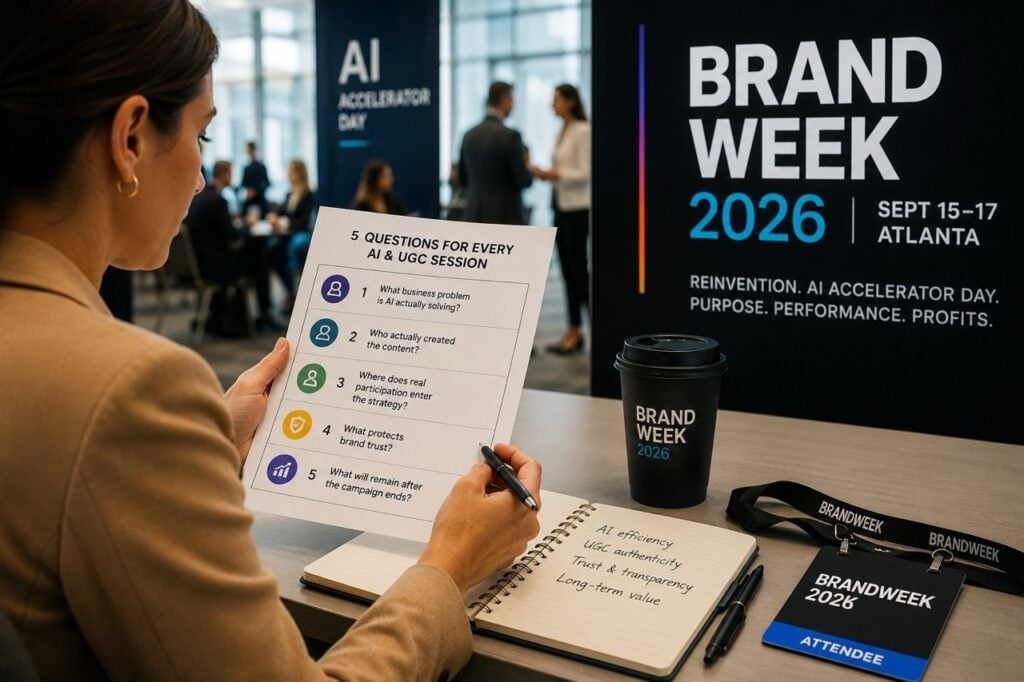
1. What Business Problem Is AI Actually Solving?
“Using AI” is not a marketing objective.
Before taking notes on a tool or case study, identify the constraint it removes. Is the technology reducing production time? Improving analysis? Making personalization affordable? Helping teams organize content? Increasing response speed?
The answer should be specific. If a speaker cannot define the original problem, the value claim will probably remain vague. Faster content production sounds valuable until the team realizes it already has more content than it can distribute or measure.
Efficiency only matters when it improves a result.
Attendees should also watch for cases where AI removes productive human involvement. Automating repetitive tagging may free a team to focus on creative decisions. Replacing genuine customer stories with synthetic testimonials does something different. It removes the source of the evidence.
The question is not whether AI completed a task.
Ask what became better because it did.
2. Who Actually Created the Content?
Content categories are becoming harder to distinguish, yet marketers still need accurate language.
A useful Brandweek session should clarify whether an asset was:
- Generated by the brand using AI
- Produced by an agency
- Created by a paid creator
- Shared by a real customer
- Submitted by an employee, fan, or community member
Each category can support a campaign. Problems begin when marketers rename one category to borrow credibility from another.
User-generated content requires a user.
That does not make AI-generated content inherently bad. It makes it different. A sound UGC strategy should preserve that distinction in briefs, reporting, rights management, and public claims.
This also has regulatory implications. The Federal Trade Commission’s rule on fake reviews and testimonials prohibits reviews that falsely appear to come from people who do not exist, including certain AI-generated fake reviews. It also addresses reviews that misrepresent a person’s actual experience.
The label is not a minor detail. It shapes what the audience believes happened.
3. Where Does Real Participation Enter the Strategy?
Many marketing presentations describe reach, impressions, and output. Fewer explain what the audience is being invited to do.
That gap matters. Participation can take many forms. A customer may submit a review. A fan may share a prediction. An employee may tell a workplace story. A community member may explain why a cause matters personally.
Each action creates something automation cannot manufacture honestly: proof that a person cared enough to contribute.
When a session discusses user-generated content, ask how participation begins. What prompts the audience? What makes the request worthwhile? What guidance do people receive? What prevents the process from feeling like unpaid production work?
Random participation is difficult to scale. Over-controlled participation feels scripted. The stronger model sits between those extremes. It gives contributors a clear subject and useful direction while protecting their own language and perspective.
Brands trying to build that model need more than a hashtag. They need a repeatable approach to collecting user-generated content at scale without creating workflow chaos.
4. What Protects Brand Trust?
Brand trust will probably appear throughout Brandweek, especially during discussions about culture, purpose, and performance.
The important question is how trust is being earned.
Edelman’s 2025 research on brand trust found that 73% of respondents said their trust would increase when a brand authentically reflected current culture. Only 27% chose a brand that ignored culture and focused solely on products.
Authenticity, however, is not a visual style. A shaky camera does not prove that a video came from a customer. Casual language does not make a synthetic persona real. An “unpolished” aesthetic can be manufactured as easily as a glossy advertisement.
Trust comes from accurate context. Attendees should ask whether audiences can understand who created the content, whether a commercial relationship exists, and whether the person had a real experience with the product or organization.
They should also ask what happens when feedback is imperfect. A UGC program that only permits praise may look controlled because it is controlled.
Brand safety matters. Total control can undermine the reason for using real voices in the first place.
5. What Will Remain After the Campaign Ends?
The final test is durability.
A campaign may produce a week of reach without creating a lasting resource. A conference case study may celebrate millions of views while saying little about what the brand learned, retained, or could reuse.
Ask what remains after distribution slows.
Did the brand build a rights-cleared content library? Did it identify recurring customer language? Did it improve its prompts? Did it create a repeatable community contribution model? Did participation become easier for the next campaign?
This is where UGC at scale differs from a collection of isolated posts.
The goal is not merely to rent attention from a platform. It is to build an owned participation loop that becomes more useful over time.
A strong program should reduce the cost and difficulty of the next content request. It should also improve the quality of what customers contribute.
If every campaign begins from zero, the strategy is not scaling.
A Brandweek 2026 Note-Taking Framework
Attendees can turn the five questions into a simple scorecard.
For each session, case study, or vendor conversation, record:
- The business problem being solved
- The true origin of the content
- The role given to customers or communities
- The trust and disclosure safeguards
- The asset or capability that remains afterward
An idea that performs well across all five areas deserves a second conversation.
An idea that only promises more output probably does not.
That is the practical opportunity at Brandweek 2026. The event can help marketers understand where AI genuinely strengthens marketing and where human participation remains essential.
Those are not competing goals.
AI can remove repetitive work, organize information, support moderation, and help teams learn from larger content libraries. Real people can provide experience, identity, emotion, and voluntary contribution.
The strongest marketing systems will know which role belongs to which.
Content is becoming easier to generate. Evidence that people care is not.
Organizations that recognize that difference are starting to build guided UGC participation systems that make authentic contribution repeatable, rather than treating customer involvement as an occasional campaign bonus.